Posts

Sex Linked Inheritance - types, X linked, Y linked, XY linked, Completely sex linked and Incompletely sex linked inheritance , cris-cross/ zig zag inheritance

Image
                                                                             Sex Linked Inheritance The transmission of body characters from parents to offspring along with a sex is called sex linked inheritance. It is also called sex linkage. The genes controlling body characters located on the sex chromosomes are called sex linked genes. The body characters (other than sex characters) controlled by genes located on the sex chromosomes are called sex-linked characters. Sex linked inheritance was discovered by T.H. Morgan in 1910. The following are the common examples for sex-linked inheritance: 1. Colour blindness 2. Haemophilia 3. Eye colour in Drosophila 4. Hypertrichosis (Hair in the ear pinna) 5. Ichthyosis hystrix. The sex linked genes are l...

Theories of Linkage:

Image
                                                                                  Theories of Linkage: VIEWS OF CLASSICAL GENETICISTS ON LINKAGE: Mendel could not notice the phenomenon of linkage because fortunately the seven pairs of factors or alleles studied by him in pea were located on seven different pairs of chromosomes. It was noticed and discovered by some other post-Mendelian geneticists who during their genetic investigations came across to linked genes. The evolution of linkage concept took place by the views of following classical geneticists: 1. SUTTON'S VIEWS ON LINKAGE: Sutton (1903) was the first classical geneticist who made certain predictions about the linkage merely by performing certain cytological investigations. He...

Linkage - principles, types, arrangement of linked genes, significance, linkage group, factors affecting linkage

Image
                                                                                          Linkage Linkage is defined as the tendency of two or more genes to remain together in the original combination in the same chromo some during the process of inheritance for a number of generations. All the genes on a chromosome are said to be linked to one another. Linkage was discovered by T.H. Morgan. Linkage was found in Drosophila, sweet peas, maize, man, etc. In Drosophila, the genes of body colour and nature of wings are linked and located on the same chromosome. In sweet pea, the genes of flower colour and size of pollen grains are linked. In maize, the genes for colour and shape of seeds are linked. In man, linked. The ge...

sex linked inheritance - Sex Limited Genes, Sex Influenced Genes, Sex Linkage, Holandric Genes, Criss-Cross Inheritance, Hemizygous, Sex Linked Lethal Genes

 Sex Limited Genes: Sex limited genes express characters in only one sex. The sex limited genes may be located on any chromosome (sex linked genes are located only on the sex chromosome). Their expression in the vertebrates is governed by the sex-hormones. Sex limited genes are responsible for the secondary sexual characteristics s as well as primary sexual characters. Examples 1. In man, the beard is produced by sex limited genes. A woman, normally, does not have a beard, yet she surely carries all the genes necessary to produce a beard. But the expression of that particular e in ladies is prevented by the absence of a particular hormone. In rare cases, abnormalities in hormone secretion may occur in a woman gene which allow these genes to express themselves and the result is a bearded lady. 2. Breast development is normally limited to woman but hormone unbalance may cause breast development in a man. 3. The genes for the deep masculine voice and masculine musculature in m...

Self-sterility in Nicotiana

Image
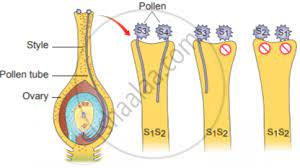
  Self-sterility in Nicotiana In plants, multiple alleles have been reported in association with self-sterility or self incompatibility.  Self-sterility means that the pollen from a plant is unable to germinate on its own stigma and will not be able to bring about fertilization in the ovules of the same plant.  East (1925) observed multiple alleles in Nicotiana which are responsible for self-incompatibility or self-sterility.  The gene for self-incompatibility can be designated as S, which has allelic series S ₁ , S ₂ , S ₃ , S ₄ and S ₅ .  The cross-fertilizing tobacco plants were not always homozygous as S ₁ S ₁ or S ₂ S ₂ , but all plants were heterozygous as S ₁ S ₂ , S ₃ S ₄ , S ₅, S ₆ .  When crosses were made between different S ₁ S ₂ plants, the pollen tube did not develop normally.  But effective pollen tube development was observed when crossing was made with other than S ₁ S ₂ for example S ₃ S ₄ .  When crosses were made between se...

Linkage in Sweet Pea

Image
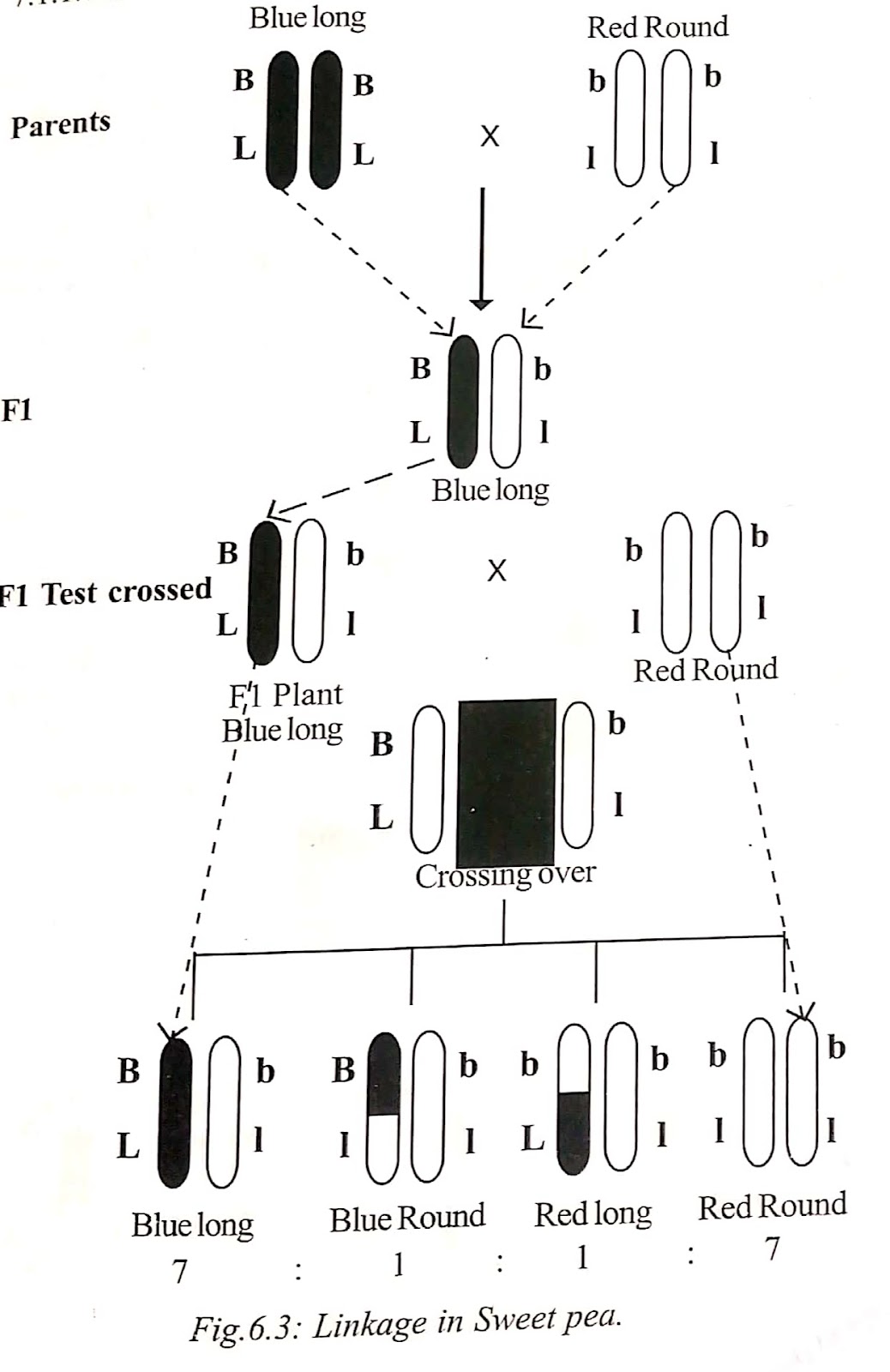
                                                                        Linkage in Sweet Pea Bateson and Punnet (1906) studied linkage in sweet pea ( Lathyrus odoratus ). In sweet pea, blue flower colour is dominant (BB) over red flower (bb). Long pollen grain is dominant (LL) over round pollen grain(ll). They crossed blue flowered, long pollen sweet pea with red flowered, round pollen plant. In these plants, the genes for flower colour and pollen shape are located in the same chromosome. That is, they are linked. The linked genotypes of the parents are written as follows: Blue flowered long pollen grained plant - BL/BL Red flowered round pollen grained plant-bl/bl The F1 plants were blue flowered with long pollen. The genotype is written as BL/bl. The F1 plant (...

Linkage in Maize

Image
                                                                            Linkage in Maize   Hutchison experimentally proved the existence of linkage in maize ( Zea mays ). In maize, coloured seed (CC) is dominant and colourless seed is recessive (cc). Full seed (endosperm) is dominant (FF) and shrunken seed is recessive (ff). A cross was made between coloured full seeded plant with colourless shrunken seeded plant. The genes for seed colour a shape are linked. i.e. C and F are linked; c and f are linked. T linked genotypes of the parents are written as follows. Colourless shrunken seeded plant cf/cf , Coloured full seeded plant CF/CF All the F1 plants are coloured and full and the genotype written as CF/cf A test cross is made by crossing the F1 pla...

Linkage in Drosophila

Image
                                                                           Linkage in Drosophila In Drosophila, grey colour(G) is dominant over black colour (g) and long wing (L) is dominant over vestigial wing (l). The genes for these two characters (colour of the body and length of the wings) are linked together in the same chromosome. The linked genotypes of the parents are written as follows: Grey long-GL/GL Black vestigial-gl/gl When a fly with grey body and long wings (GGLL) is crossed with another fly having black body and vestigial wings (ggll), all the F, individuals are having grey body and long wings (GgLI). When F, male hybrid is test crossed with the double recessive parent, the F, contains only two types of individuals in equal numbers (1:1...

Coupling and Repulsion - definition and experimental proof

Image
                                                                           Coupling and Repulsion                   Bateson and Punnet in 1906 proposed the hypothesis of coupling and repulsion to explain the later proposed linkage.  Coupling: The tendency of two dominant alleles or recessive alleles coming from the same parent tend to enter the same gamete and Coupling inherit together is called coupling. Experimental Proof for Coupling:                       W. Bateson and RC. Punnet in 1906 reported the phenomenon of coupling and repulsion (linkage) in sweet peas. A sweet pea with blue flower (B) and long pollen grains (L) is crossed with one having red flower ...

Allelic Interactions - dominant and recessive alleles, codominant alleles, lethal alleles, penetrance or expressivity, multiple alleles

Image
                                                ALLELIC RELATIONSHIP   Dominant and Recessive Alleles:   Whenever one of a pair of alleles can come to phenotypic expression only in a homozygous genotype, we call that allele a recessive factor. The allele which can phenotypically express itself in the heterozygote as well as in the homozygote is called a dominant factor. Upper- and lower-case letters are commonly used to designate dominant and recessive alleles respectively. Usually, the genetic symbol corresponds to the first letter in the name of the abnormal (or mutant) trait.   (a) Carriers:   Recessive alleles (such as the one for albinism) are often deleterious to those who possess them in duplicate (homozygous recessive genotype). A heterozygote may appear just as normal as th...

Root Modification in taxonomy

Image
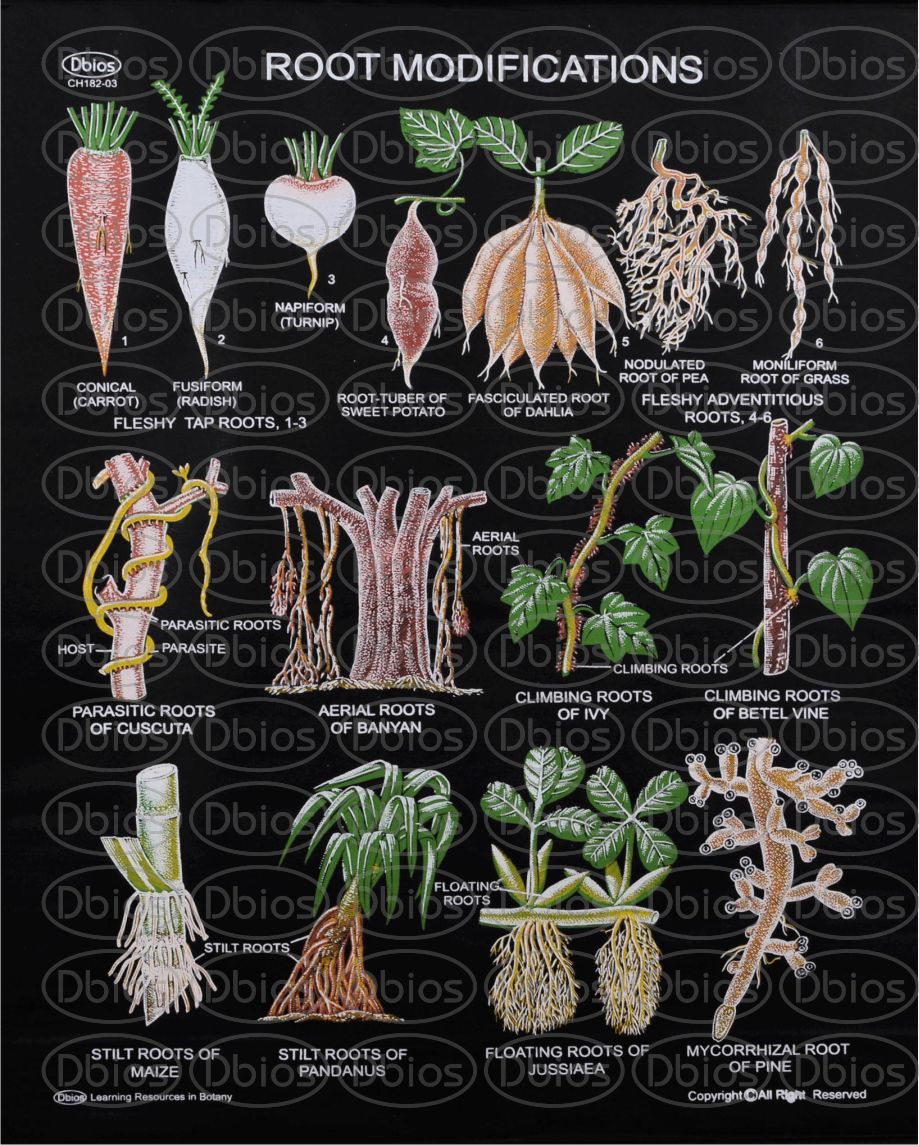
                                                                Modifications of root Tap root modification:   Storage roots: 1. Conical Root These are cone like, broad at the base and gradually tapering towards the apex. Example: Daucus carota. 2. Fusiform root: These roots are swollen in the middle and tapering towards both ends. Example: Raphanus sativus 3. Napiform root: It is very broad and suddenly tapers like a tail at the apex.   Example: Beta vulgaris Breathing root: Some mangrove plants like Avicennia, Rhizophora, Bruguiera develop special kinds of roots (Negatively geotropic) for respiration because the soil becomes saturated with water and aeration is very poor. They have a large number of breathing pores or pneumatophores for exchange o...

Mendelism- Reasons for success, Characters selected by Mendel and Mendels laws

Image
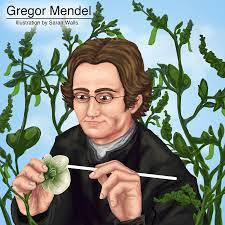
                                                                                  MENDELISM The contribution of Mendel to Genetics is called Mendelism. It includes all concepts brought out by Mendel through his original research, on plant hybridization. Genetic laws proposed by Mendel are universal to most genes in microbes, plants and animals. Mendelian genetic concepts are basics to modern geneticists. Therefore, Mendel is called the Father of Genetics.   Mendel: Mendel is the Father of Genetics. He was born in a peasant family in 1822 in Austria. He worked as a teacher. He passed his later life as an abbot. He died in 1884. Mendel was fond of gardening and fruit-culture from his boy hood. When he was working as teacher, he perform...

Theories of Meristem Organization and Function

Image
                                                    Theories of Meristem Organization and Function Many anatomists illustrated the root and shoot apical meristems on the basis of number and arrangement and accordingly proposed the following theories – An extract of which are discussed below. Shoot Apical Meristem: Apical Cell Theory: Apical cell theory is proposed by Hofmeister (1852) and supported by Nageli (1859). A single apical cell is the structural and functional unit. This apical cell governs the growth and development of whole plant body. It is applicable in Algae, Bryophytes and in some Pteridophytes. Histogen Theory: Histogen theory is proposed by Hanstein (1868) and supported by Strassburgur. The shoot apex comprises three distinct zones. 1. Dermatogen: It is a outermost layer. It gives rise to epidermis. 2...